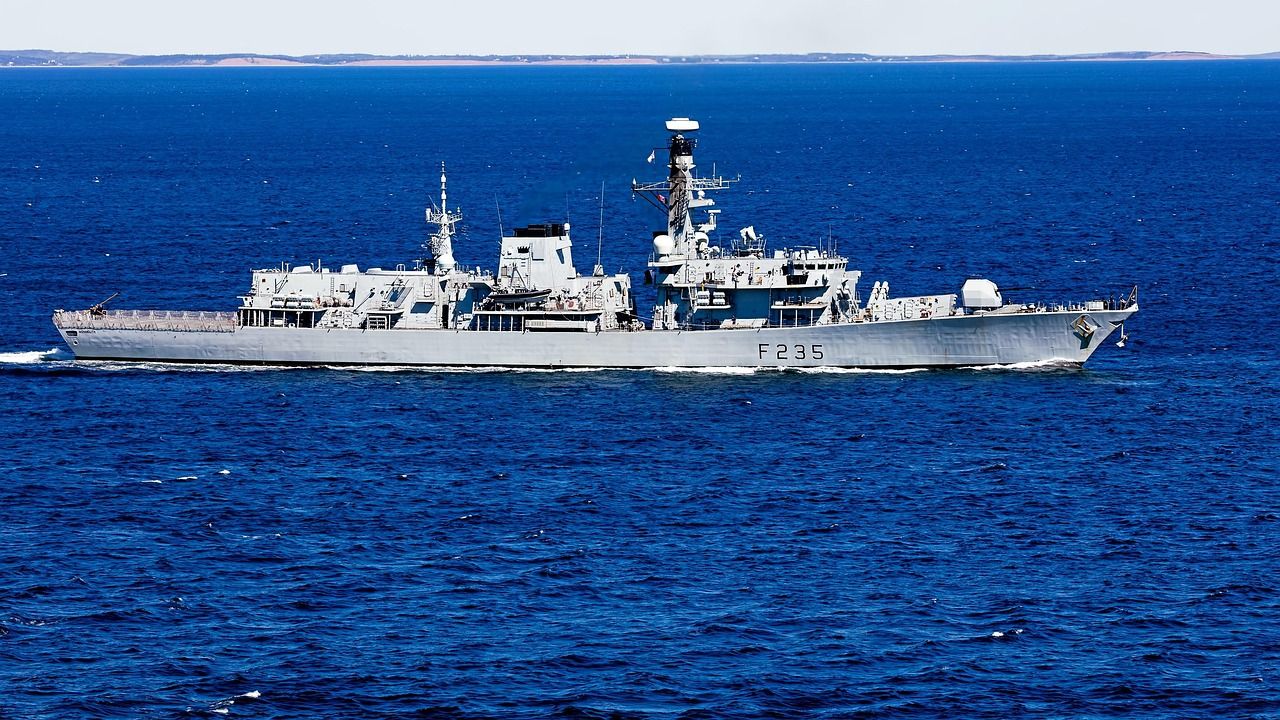
In 2017 the then First Sea Lord, Admiral Sir Philip Jones, announced that the Royal Navy aimed to develop a ship's "mind" under Project Nelson. Nine years later, I found no public verdict on whether it was ever built, or who assured it.
Two admirals, two years apart
In September 2015, Admiral Sir George Zambellas, then First Sea Lord, spoke at the Defence and Security Equipment International exhibition. He said that deploying "intelligent systems at sea, under the sea, in the air and on land" would "revolutionise maritime operations." He named autonomy as one of six technologies set to remake the Royal Navy, alongside additive manufacturing, novel weapons, interoperability, data and people. The claim was early and confident, made eleven years ago, and it named autonomy without using the words "artificial intelligence" or placing anything at the heart of a warship. What Zambellas described reads closer to unmanned systems and networked sensors at the edges of a fleet than to a single governing intelligence at its centre.
Two years later, in September 2017, his successor Admiral Sir Philip Jones stood at the same exhibition and said it plainly: "Artificial Intelligence is also an important part of this future. Under Project Nelson, the Royal Navy aims to develop a ship's 'mind' at the centre of our warships and headquarters to enable rapid decision making in complex, fast moving operations." That is a Royal Navy AI system with a name, a purpose and a location, described by the officer who would have owned the decision to fund it.
The trail Project Nelson leaves
Project Nelson had been reported the previous year in trade coverage that described the Royal Navy as "keen to explore the potential of using machine-learning to improve operational capability in its fighting units" (The Register, 2016). The same coverage described a related programme called STARTLE, built by Roke Manor Research, which used neural networks to flag threats from sensor data and explicitly logged its own decisions for a human to sign off. Explainability and human sign-off were therefore being built into a Royal Navy AI system in 2016. Seven years later, that pairing of transparency and human oversight became a named requirement for AI management systems generally (ISO/IEC 42001, 2023). The timing suggests that the design principle arrived because the engineers building STARTLE judged it necessary, years before any standard required it.
The clearest later trace of the programme is a single sentence in the Navy's own digital strategy, citing "the advent of NELSON, Navy X and other initiatives" in a section about attracting digital talent (Royal Navy, 2022). It gives no further account of what the programme delivered, how it was assured, or whether the ship's mind Jones described was ever built as described. I found no public verdict on Project Nelson itself, and the assurance regime that was meant to surround it has left no visible public record of its own. An unaudited programme may be a harder problem to reckon with than a failed one, since a failure at least leaves evidence behind.
Where I stood in this
In 2019, while researching my own dissertation on fuel-consumption forecasting, I interviewed engineers working on Project Nelson directly. Those conversations showed that the Navy was exploring machine learning for the very problem the dissertation examined, so the dissertation went on to propose using artificial neural networks against the same data. The later literature on AI assurance gives that fieldwork more weight now. The interviews took place inside a capability that had no governing standard yet, while the dissertation worked on the same problem from outside it.
The gap that opened first
Engineering Trust (James, 2026) argued that Deloitte and Boston Consulting Group are now describing, for AI-enabled enterprises, an assurance destination that military logistics has been operating close to for years. Project Nelson complicates that argument usefully, because it shows the same institution reaching for the AI capability years before it had any governance standard to point at. Jones asked for a ship's mind in 2017. ISO/IEC 42001, the first international standard for AI management systems, was not published until 2023. The Deloitte and BCG papers making the case for assurance engineered into AI systems by design arrived only this September (McNulty et al., 2026; Coppola and Kleppe, 2026), eleven years after Zambellas's speech and nine after Jones's. The capability ambition and the governance instrument to assure it did not run on the same clock here, and the pattern may hold elsewhere. That is a more defensible version of the earlier argument.
The argument in Engineering Trust rested on a discipline that does not depend on knowing in advance what kind of system it will be asked to assure. It consists of judgement exercised close to the risk, graded inspection with consequences and a mandatory reckoning when ownership changes hands. Project Nelson's silence in the public record may reflect a capability that arrived before that discipline was attached to it. The Deloitte and BCG papers can be read as a proposal to attach it now, at enterprise scale, to a technology that has already been running for years without it.
What I would want to know
What happened to Project Nelson remains unknown on the public record, and a tidier ending would be a guess. The question worth putting to either admiral now is who was accountable for reporting whether the ship's mind was built, and whether that accountability survived the change of command between them. The same question recurs across this site under different names: does the record match reality, and was an announced capability ever assured? Closing that gap takes deliberate work, whichever technology is involved.
The views expressed here are my own and are based on general observations about defence technology history and AI governance. They draw only on published sources and do not represent the position of the Royal Navy, the Ministry of Defence or any organisation with which I work. Nothing published here reproduces any organisation's internal policy, procedure or assurance output.
References
- Admiral Sir George Zambellas, First Sea Lord, speech to the Defence and Security Equipment International Naval Technology Zone, "Think Navies, Think Technology," 15 September 2015.
- Admiral Sir Philip Jones, First Sea Lord, speech to the Defence and Security Equipment International Naval Technology Zone, 12 September 2017.
- "AI, AI, captain: Royal Navy warships to set sail with computer officers," The Register, 18 October 2016.
- Royal Navy, Digital and Data Plan 2022–2025, Ministry of Defence, December 2022.
- International Organization for Standardization, ISO/IEC 42001:2023, Artificial Intelligence Management Systems.
- James, K., "Engineering Trust: Assurance When the Human Leaves the Point of Work", kelroyjames.com, September 2026.
- James, K., "A Dissertation About the Job I Was Already Doing", kelroyjames.com, September 2026.